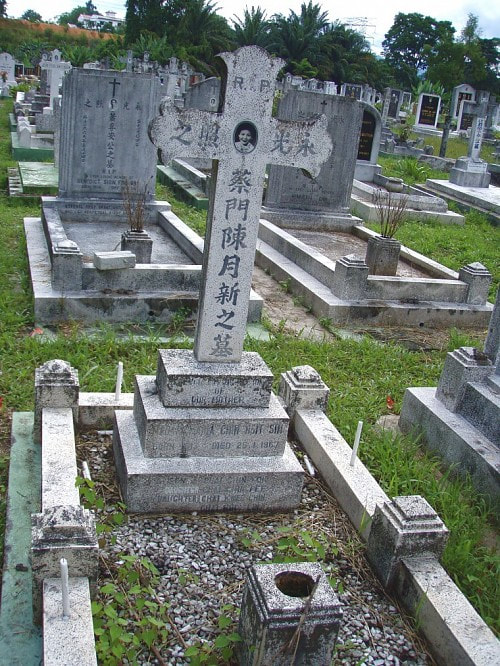
Paying respects to mi's parents with di
2021-01-30
1 May 2007.
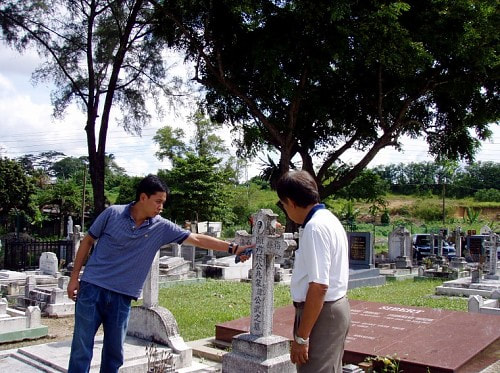
We often went for long drives before you were tied down with Jess' schedules, and every year, we would visit mom's parents' grave-sites to ensure they were properly clean and cleared. I still always have a pack of joss-sticks and candles in the car, just to be prepared. On this particular day, the sun was out in full force when we arrived, about 3:30pm, so we three, along with Yuan long, returned with the usual extra shade of gold, but I enjoy being under the sun for long stretches once in a while.
Thanks to you, here is what I know of mom's parents:
Both her parents were Catholics, and are laid to rest at the Catholic Burial Ground in Seremban.
It was hard even then to translate the Chinese characters on the gravestones because the words have faded,
and Di was planning to get them re-drawn by a professional. Dad and mom were the ones who made all the arrangements
for both her parents. They were fortunate to have a very kind and well-known carver whom they knew, approach them
and asked them for permission to help with the carving of the gravestones.
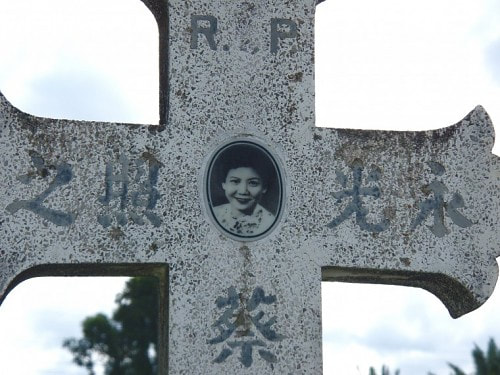
The following information is carved on her mother's gravestone.
The Chinese characters, from top and read from right to left, after the words,
R.I.P.
Eternal Light (First 2 characters on the right of the cross);
Ever Glowing (Following 2 characters on the left of the cross);
Vertical characters, from the top, first 2 characters:
Under the honourable family name of Chai
Next 3 characters:
Chan Yeet Sarn [Surname, Chan; Given name, Sarn (bright new) Yuet (moon)];
Last 2 characters:
Che Mou (of grave): Final resting place.
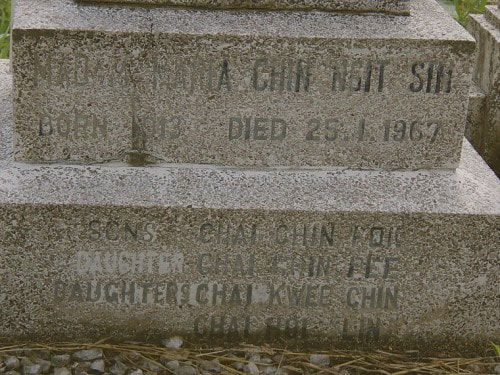
First base of gravestone, in English:
IN EVER LOVING MEMORY
OF
OUR MOTHER
Second base of gravestone:
MADAM MARIA CHIN NGIT SIN
BORN 1913 - DIED 25.1.1967
Third base of gravestone:
SONS
CHAI CHIN HOW
CHAI CHIN PEE
DAUGHTERS
CHAI KWEE CHIN
CHAI HOY LIN
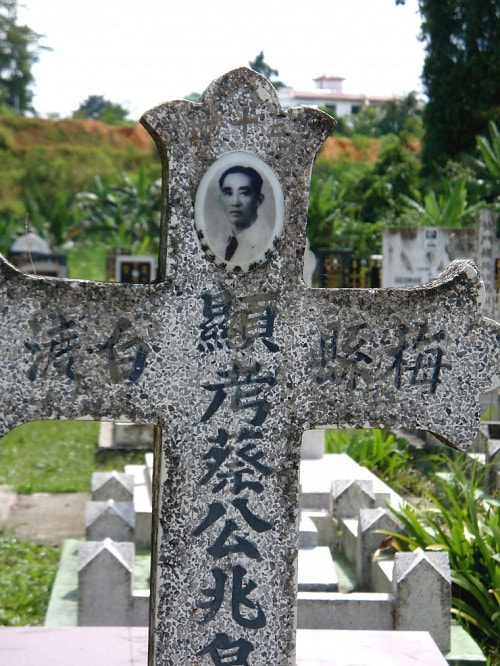
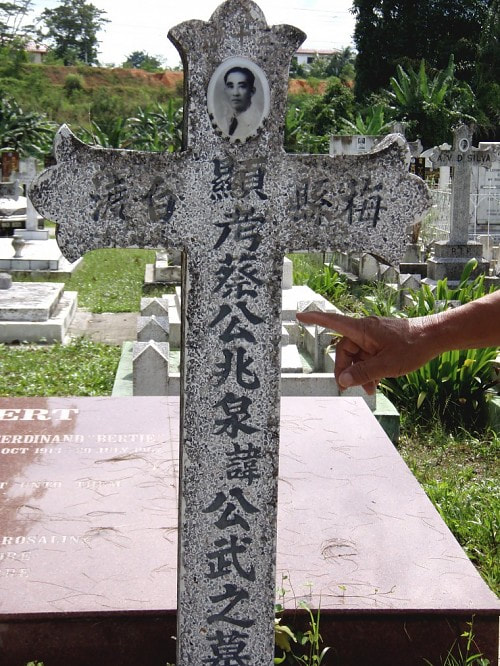
The following information is carved on her father's gravestone.
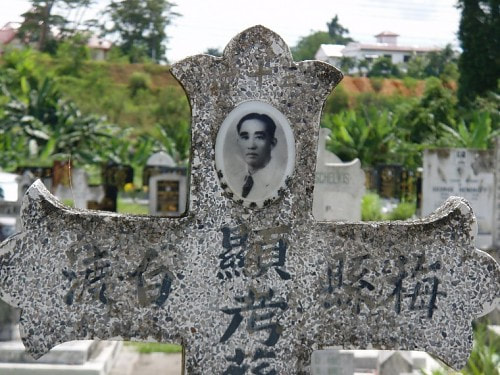
Sadly, the Chinese characters at the top have faded, except for the first and second characters,
which are read, in old Chinese characters, from right to left:
Erm-sap (fifty)
From right to left the first 2 characters on the cross, “Mei Sien.”
“Mei” is the name of the main location i.e. the province of ‘Mei’ or in English, The Province of Splendour
“Sien” is the name of the secondary location within the main location i.e. The Town of ‘Sien’
To date, I have not been able to get anyone to help translate this ancient Chinese character, so I cannot tell what 'Sien' means, in English.
2 characters on the left of the cross, “Pai Tuk”
This is the name of the town, or village within the secondary location, i.e. The Village of ‘Pai Tuk’
Again, I have no translation for the meaning of 'Pai Tuk.'
Now, from the top and vertically, from below the photograph:
First 2 characters, “Sien Kau” is a title for renowned Chinese leaders,
i.e. an emperor of a Chinese province, something like ‘His Majesty’ or ‘His Royal Highness.’
Third character, “Chai” is his surname (pronounced “Choy”)
Fourth character, “Kong” is a rare description for ‘warrior’ or ‘conqueror’
Fifth and sixth characters are “Siew Chuen”
Now, there is supposed to be a "full meaning," something hidden, like a stanza,
by reading the third to sixth characters, which represents his full name and title: Choy Kong Siew Chuen, which directly translates to mean, HRH Chai (Choy Kong) Siew (Lavish fortune) Chuen (Stream) i.e. HRH Chai, Stream of lavish fortune.
The seventh character, which is of a smaller and different typeface, is “Wei,”
which I have not been able to find anyone to help decipher, particularly as it is a very rare, old Chinese character.
The eighth and ninth characters are “Kong Mou,” which is different kind of royal title.
The tenth and eleventh characters are “Chee Mou,” - again, characters which I have not been able to find
anyone to help decipher.